

What to Do When Pipes Freeze in Your Bristol, TN Home
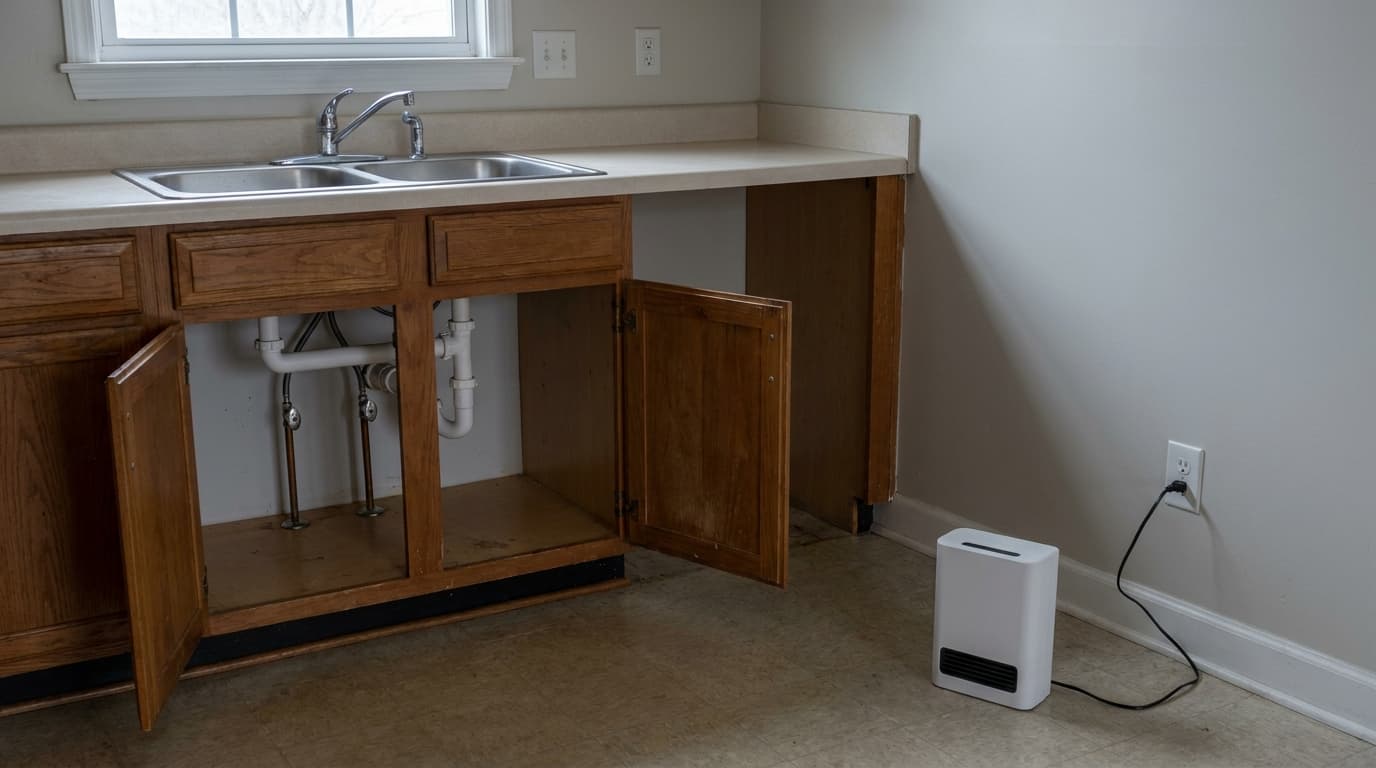
If you turned on a faucet this morning and got a trickle instead of a stream, and it is cold outside, you probably have a frozen pipe. Take it seriously, but do not panic. A frozen pipe is often something you can handle yourself. A frozen pipe that splits while nobody is watching is a much larger problem, and the next hour mostly decides which one you end up with.
We handle water damage restoration in Bristol and across the Tri-Cities, and freeze calls here follow a pattern. Bristol sits at the cold end of our region, and we get a handful of genuinely hard nights a season rather than a whole winter of them. Houses built for the milder average pay for the exceptions.
This is the order we would work in. One thing up front: we do not repair plumbing. A plumber fixes the pipe; we deal with what the water did.
Get Your Quote
Ready to handle this with a pro?
You're reading about How Do You Know a Pipe Has Frozen in Your Bristol Home. Get a fast quote for water damage restoration service in Johnson City, TN from Conrad's Water Damage and Fire Restoration.
How Do You Know a Pipe Has Frozen in Your Bristol Home?
The faucet tells you first. The American Red Cross guidance on frozen pipes puts it in a line: "If you turn on a faucet and only a trickle comes out, suspect a frozen pipe." Nothing at all from one fixture while the rest of the house runs normally points the same direction.
It helps to know why this happens here, because it is easy to assume freezing is a Northern problem. Research published in 1996 by the Building Research Council at the University of Illinois instrumented a deliberately vulnerable pipe — uninsulated, in a vented attic. Across eleven freeze events that winter it began freezing with what the researchers call "remarkable consistency" at or just below 20°F, and they proposed 20°F as a "temperature alert threshold" for the Southern states, where building practice does not anticipate the cold.
Read that as a risk line, not a safety line. The same report says "isolated, infrequent, freezing incidents will occur at overnight temperatures above the threshold, between 20 and 32°F," and that a hole or crack in the shell of a house can put a pipe in trouble that looks protected on paper. Bristol does not spend its winters below 20°F. It gets there, and those are the nights we hear about.
Where to look, roughly in order:
Against exterior walls, and where the water service enters through the foundation. Red Cross names both, and they are what we find most often.
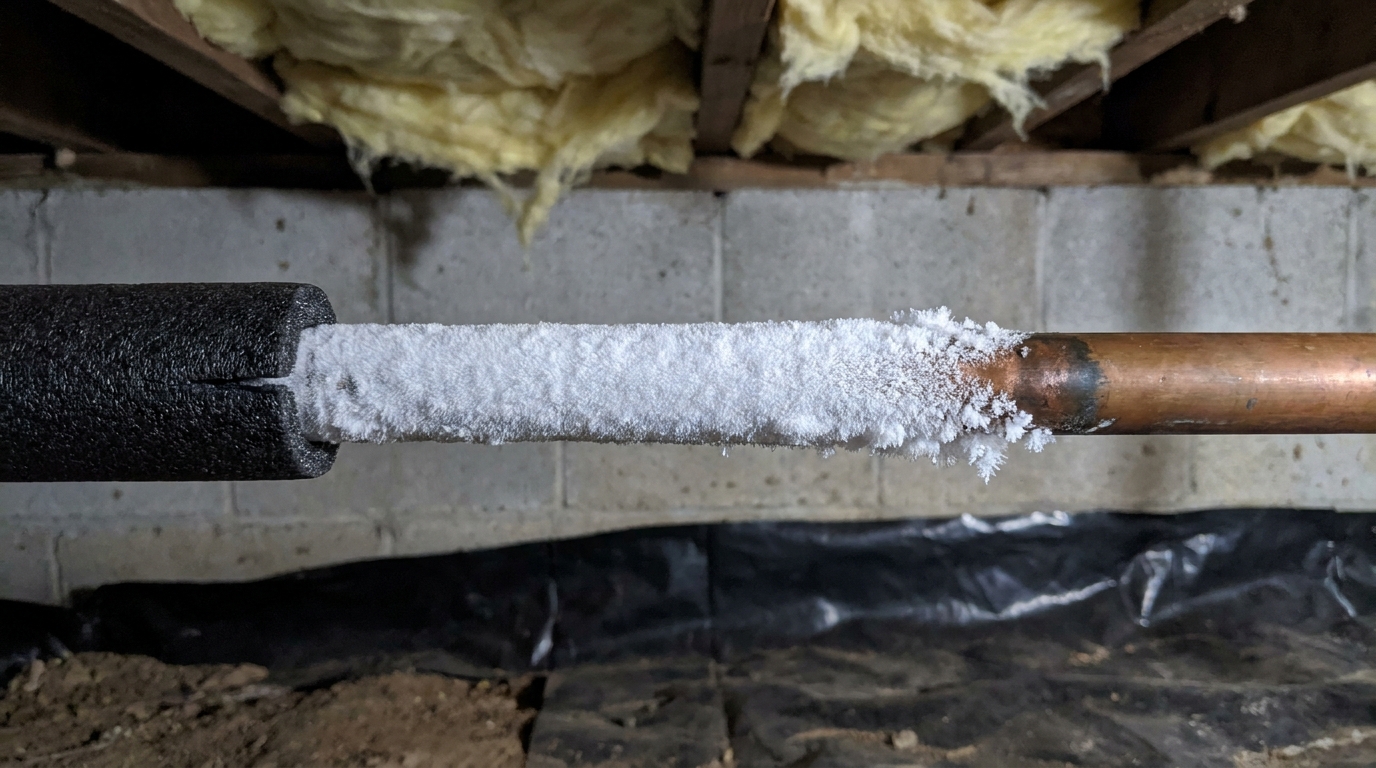
The crawlspace. Most older houses here sit on one, it runs close to outdoor temperature, and the lines under the floor are often uninsulated or wrapped in sleeves that have slipped over the years.
Unheated spaces, and the back of a cabinet on an outside wall.
Frost or a bulge on the pipe itself, if you can see it.
Then check every other fixture. Red Cross is direct: "If one pipe freezes, others may freeze, too." A frozen line is a report on the temperature in that part of your house, not a coincidence.
How Do You Thaw a Frozen Pipe Safely in a Bristol House?
Open the faucet that pipe feeds, and leave it open. That does two jobs: as the ice melts, water running through the pipe helps melt the rest, and an open tap gives pressure somewhere to go.
Then find the frozen section and warm it, working from the faucet end back toward the blockage so meltwater has an open path out ahead of it.
Red Cross gives a specific list and a specific prohibition: "Apply heat to the section of pipe using an electric heating pad wrapped around the pipe, an electric hair dryer, a portable space heater (kept away from flammable materials), or by wrapping pipes with towels soaked in hot water. Do not use a blowtorch, kerosene or propane heater, charcoal stove, or other open flame device." Keep going until full pressure comes back, not just until you get a dribble.
Three things not to do, and the first turns a plumbing problem into our other line of work:
No open flame, ever. A torch can set framing alight inside a wall you cannot see into, and it can damage the pipe you are trying to save.
Do not leave a space heater unattended, and do not aim one into a closed cabinet. The U.S. Fire Administration reports that portable heater fires were only 3% of home heating fires annually for 2017 to 2019, but accounted for 41% of fatal heating fires in homes. Keep anything that can burn at least 3 feet from the heater, and switch it off when you leave the room. A cabinet packed with cleaning bottles is not 3 feet of anything.
Do not run an electric appliance while standing in water. If there is already water on the floor, the job has changed.
If it will not thaw, or you cannot find it, stop rather than escalate. That case has its own section below.
How Do You Stop the Damage When a Bristol Pipe Bursts?
Close the main. Everything else waits. The valve is usually where the water first enters the house, often in a crawlspace, a utility closet, or near the meter at the street. If you do not know where yours is, find it tonight rather than during the event.
Then, in order: open faucets to drain the system down, kill the breakers for any circuit where water is near outlets or fixtures, and call a plumber for the pipe. Photograph everything before you move it — what your policy covers is a conversation for your agent, but the documentation window closes when cleanup starts.
Here is the part almost nobody explains, and it is why so many of these calls come in late.
A burst pipe usually does not leak when it bursts. The Illinois research states it flatly: "A burst water pipe does not immediately result in the flooding of a building. Because a complete ice blockage is necessary to create a rupture, it follows that the rupture is initially sealed by the ice blockage from any substantial water flow. A flooding condition will occur when the ice blockage thaws out, and the burst location is back in communication with the water system."
In plain terms: the ice splits the pipe, then corks the split. Nothing comes out. Then the house warms, the plug melts, and the opening is connected to a live supply line. A quiet morning after a hard freeze is not proof that nothing broke.
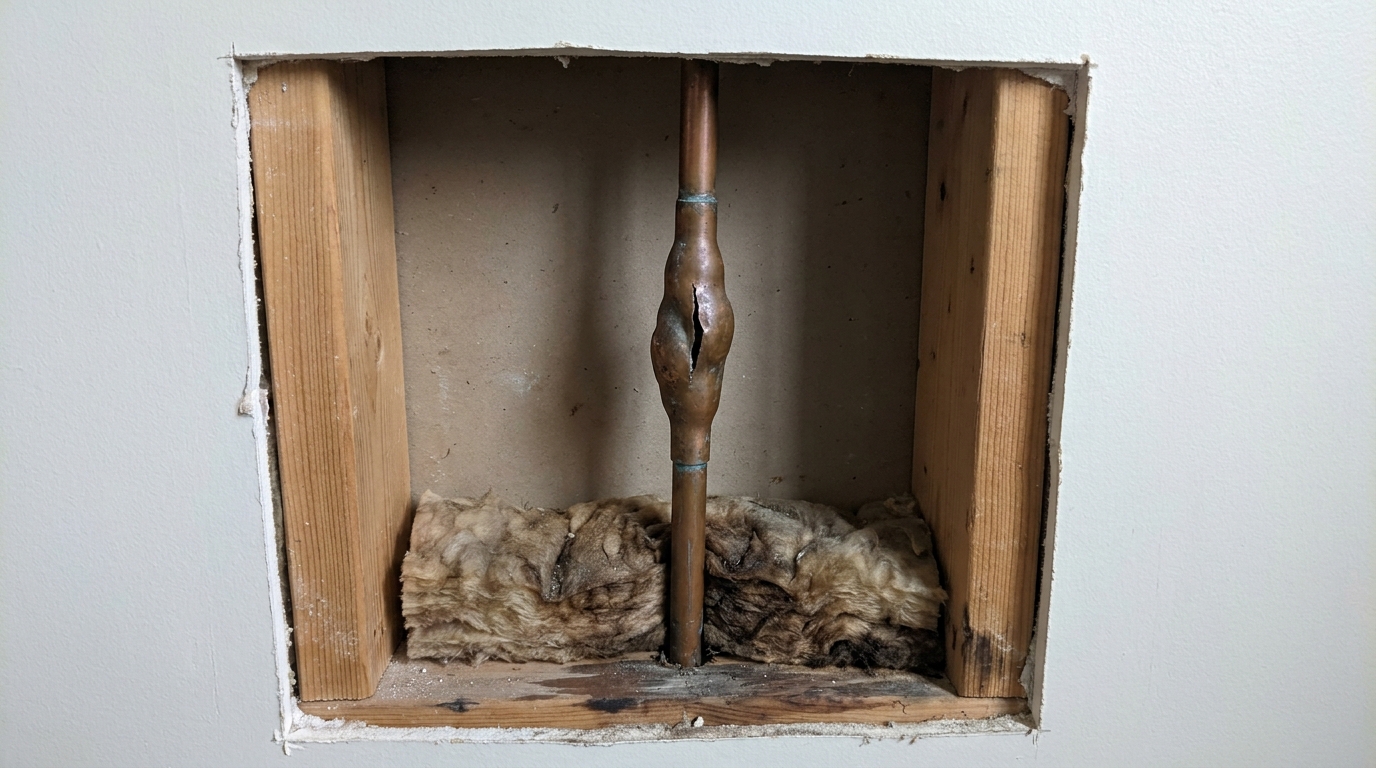
What the water does next is our half of the job. Water at household pressure does not stay where it started. It follows framing, runs along the top of a bottom plate, saturates the batt insulation in the bay and drops into the subfloor. Wet fiberglass stops insulating and holds moisture a long time inside a closed cavity. The wet patch on your ceiling or baseboard marks where the water came out, not where it has been, which is why pulling standing water out of a house is only the visible part of the work.
Get Your Quote
Ready to handle this with a pro?
You're reading about How Do You Keep Pipes from Freezing in a Bristol Cold Snap. Get a fast quote for water damage restoration service in Johnson City, TN from Conrad's Water Damage and Fire Restoration.
How Do You Keep Pipes from Freezing in a Bristol Cold Snap?
Almost everyone knows to drip the faucets, and almost everyone is told it is because moving water does not freeze. That is half right, and the real reason changes how you do it. The Illinois research found a pipe bursts when a complete ice plug forms and keeps growing, driving the trapped water past what the pipe can hold — burst pressures measured at 4,000 psi and up, against a house supply of roughly 42 psi. Flow alone does not reliably stop that: "Water flow will delay freezing, but it may not prevent it in all cases. By opening a tap even slightly, pressure relief has been provided at the furthest downstream point that will prevent pressure buildup and ultimately bursting."
Three things follow, and they are what people get wrong:
Drip hot and cold. The two reach a fixture on separate lines, "each of which could be subject to freezing, so it is necessary that each line contributes to the induced flow." Dripping only the cold tap protects only the cold line.
Leave the tap open even if the drip stops. Keep it "in the slightly open position, even if the ice blockage causes the dripping to stop or slow down." A drip that quits is a sign ice has formed, which is when the open tap matters most.
Pick the fixture farthest from where the water comes in, so the relieved run covers as much of the house as possible.
The rest of the checklist, most of it straight from Red Cross:
Hold the thermostat at one temperature day and night. The overnight setback is what catches people; a higher heating bill beats "a much more costly repair job if pipes freeze and burst."
Open cabinet doors under sinks, moving the cleaning chemicals out of reach of children first.
Keep the garage door shut if there are supply lines in there.
Insulate the exposed runs, carefully. Commercial insulation at 1 to 2 inches thick outperforms the thin hardware-store variety, and gaps let one isolated stretch freeze ahead of the rest — the setup that bursts pipes.
Remember heat tape needs power. It "will not work, of course, in the case of a power outage," and in the county towns a power cut takes the well pump with it.
Going away in winter? Leave the heat at no lower than 55°F, or shut the water off at the main and open the taps to drain down. The second is stronger: with the supply off and the valves open, there is nothing in the pipes to freeze.
Which Bristol Pipes Freeze First, and How Do You Protect Them?
Red Cross groups the usual casualties three ways: pipes exposed to severe cold, like outdoor hose bibs and sprinkler lines; supply pipes in unheated interior areas like crawl spaces, attics, garages or kitchen cabinets; and pipes running against exterior walls with little or no insulation.
Here the middle category does most of the damage, and the crawlspace does most of that. That single run of pipe under the floor is behind a large share of the water damage work we take on around Johnson City and the rest of the Tri-Cities after a hard freeze.
Two protections are worth doing before the first cold night rather than during it:
Deal with the hose bibs. Red Cross gives the sequence: remove, drain and store the hoses, close the inside valves feeding the outdoor bibs, then open the outside bibs and leave the outside valve open "so that any water remaining in the pipe can expand without causing the pipe to break." An attached garden hose holds water against the bib all winter.
Close the holes. Air leaks around rim joists, crawlspace vents and foundation penetrations put cold air straight onto pipes that look protected: "Holes in the exterior shell of a house can play a major role for pipes that would otherwise appear protected."
When Should a Pro Handle Frozen Bristol Pipes?
Red Cross draws the line clearly, and we would not move it: "If you are unable to locate the frozen area, if the frozen area is not accessible, or if you can not thaw the pipe, call a licensed plumber."
That middle clause is where most people get stuck, and where nearly every article on this subject quietly ends. If the pipe is inside a wall, under a slab, or deep in a crawlspace, a hair dryer aimed at drywall is not doing much.
The honest answer is that heat where you think the pipe is, is not the same as heat on the pipe. In a long-running homeowner discussion on exactly this problem, one homeowner described opening the wall in several places to hunt for the freeze and finding it about 8 to 10 feet from where they had been aiming a hair dryer under the sink. Once they were on the actual frozen section, the hair dryer had water flowing within 45 seconds. Two of the most upvoted people in that thread landed on the same answer — open the wall where the pipe is, thaw it properly, and fix the insulation problem while it is open. Another commenter gave the reason: if it is frozen hard enough that nothing flows, it may already have split, and the leak will start inside the wall the moment it thaws.
Short of opening anything, you can raise the whole house temperature and give it hours rather than minutes. Ambient heat works. It is just slow.
Call a plumber when you cannot find it, cannot reach it, cannot thaw it, or when the pipe has clearly burst. Call us when the water has already been somewhere. A plumber makes the pipe hold water again; we deal with what soaked into the house while it did not. If a burst wet insulation, framing or subfloor, that needs drying equipment that pulls moisture out of the structure itself rather than fans pointed at a damp wall. We answer the phone around the clock, day or night, holidays included, and Bristol sits inside our emergency services 60 minute response time. We will also tell you when what you have is a plumbing repair and a couple of towels.
Get Your Quote
Ready to handle this with a pro?
You're reading about Key Takeaways. Get a fast quote for water damage restoration service in Johnson City, TN from Conrad's Water Damage and Fire Restoration.
Key Takeaways
A trickle instead of a stream on a cold day means suspect a frozen pipe — then check every other faucet, because if one line froze, others may have too.
Risk climbs sharply below about 20°F, the threshold the Illinois research proposed for Southern states. That is not a guarantee of safety above it: the same report expects occasional freezes between 20 and 32°F.
Open the faucet first, then apply gentle heat from the faucet end back toward the blockage — heating pad, hair dryer, space heater clear of anything flammable, or hot-water-soaked towels. Keep going until full pressure returns.
Never an open flame, never an unattended space heater aimed into a cabinet, never an electric appliance while standing in water.
If it bursts, close the main first, then drain the taps, kill power to any wet circuits, call a plumber, and photograph everything before you move it.
A burst pipe usually will not leak until it thaws, because the ice plug seals its own split. A quiet house after a freeze is not proof that nothing broke.
Drip hot and cold at the farthest fixture, and leave the tap open even if the drip stops. Pressure relief is the part that prevents a burst.
Hold one thermostat setting day and night, keep the garage door shut, open the cabinets, and insulate the exposed runs. Heat tape only works while the power is on. Leaving in winter, either hold at 55°F or shut the water off and drain down.
Call a plumber when you cannot find it, cannot reach it, or cannot thaw it. A plumber fixes the pipe. We dry the house.
Conrad's Restoration Team
Water, Fire & Mold Restoration Crew
The restoration crews at Conrad's Water Damage and Fire Restoration handle water, fire and mold damage across Johnson City, the Tri-Cities and the Knoxville corridor. Someone answers the phone day or night, holidays included.
Related Posts
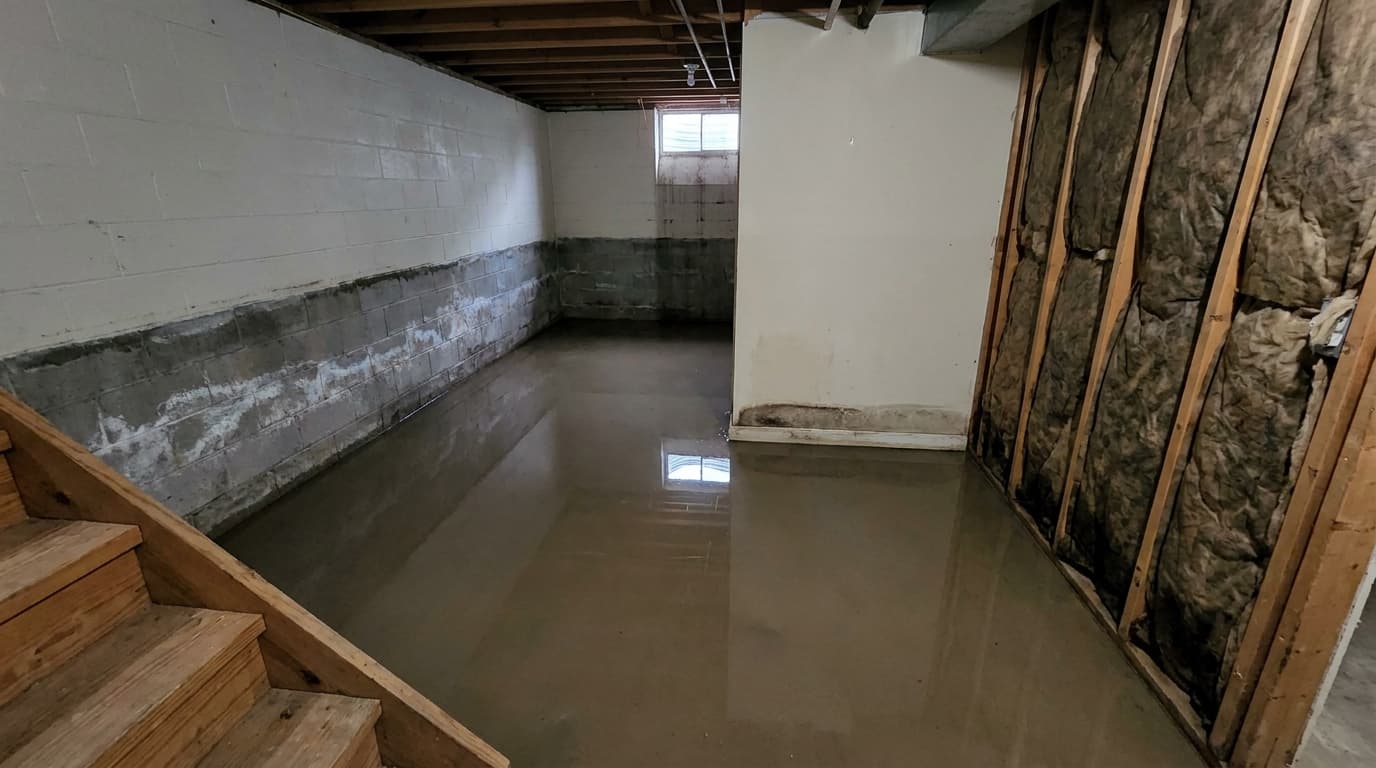
Flooded Basement in Johnson City, TN? What to Do First
Water in your Johnson City basement? Power and gas come first, then stopping the source, then the sump pump check almost nobody writes about.
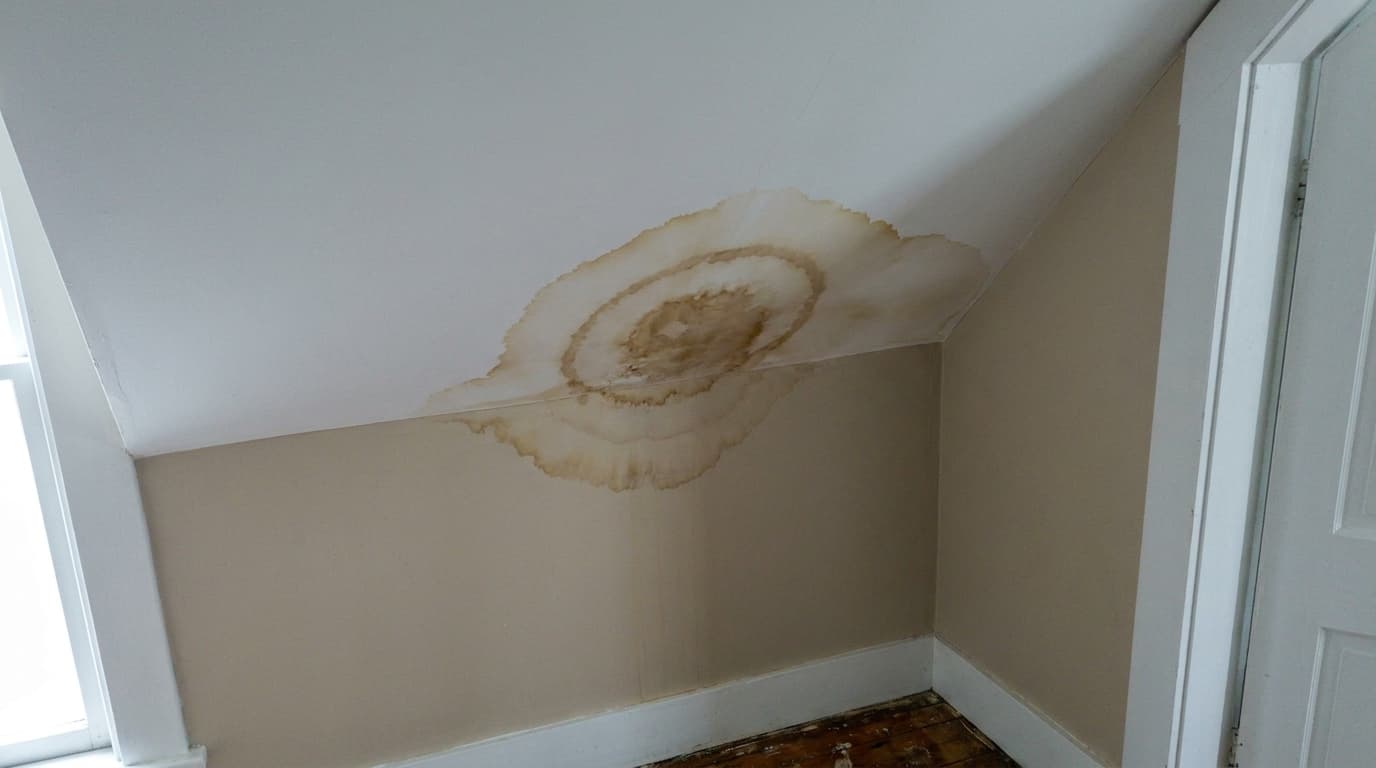
Ceiling Water Damage in Kingsport: Signs, Causes, and Fixes
A brown ring proves water was there. It does not prove water is there now. How to read a Kingsport ceiling stain, and when primer is the wrong answer.
Does Homeowners Insurance Cover Water Damage in Knoxville?
Most water claims are decided by one question: how the water got out, and how long it had been getting out. Here is what a Knoxville homeowners policy generally covers, what it almost never touches, and what to document before the adjuster arrives.